Showing posts with label Shared Alzheimer's Info. Show all posts

Wednesday, August 24, 2011

Second great article from USA today....Pat Summitt

She's to be recognized for her willingness to come out and admit her diagnosis. A cure will only be found through awareness. No shame here, just tough as nails....I LUV IT! 


Alzheimer’s disease experts Tuesday hailed Pat Summitt for her decisions to go public with her diagnosis of early onset dementia, the Alzheimer’s type — and to go forth with her coaching career.

“She deserves tremendous credit for announcing her illness,” says John Morris, a physician and director of the Alzheimer’s disease research center at Washington University in St. Louis who is not involved in her treatment. “This under scores the point that people who are not older can also get dementia. It is key for others to know by recognizing and diagnosing early she, and others, can still function at a very high level for some time to come.”

Wednesday, July 27, 2011

Gail Sheehy must be living in the walls of the caregiver's home.....

Gail Sheehy: Managing Midlife Stress

by Gail Sheehy on July 26, 2011 ·

What midlife women can do to inoculate themselves against depression, obesity, and other chronic illnesses that come with raising children while caring for aging parents


Today’s midlife women should be much healthier and happier than their mothers were in the same life stage, right? Mom was probably less well-educated, didn’t jog or pump iron, and was clueless about how to handle menopause and avoid osteoporosis. Why, then, according to startling findings of a longitudinal study by Gallup-Healthways, do middle-aged American women now have the lowest well-being of any other age group?

One key reason is the physical and emotional stress of family caregiving.

The average profile is a 49-year-old woman who still has at least one child at home and works outside the home while juggling another 20-hour work week caring for an aging family member.

“I already had three jobs before my mother and father-in-law got sick,” says Bonnie Heath. Between dropping off and picking up her two children at different schools, she put in six hours as a substitute teacher, then rushed to her mother-in-law’s home to lift her from wheelchair to an SUV and drive her to physical therapy every day, then back to pick up her father-in-law for an appointment with one of his six doctors.

“I was never home in time to make dinner for my family,” Heath continues. She and her husband David had to give up the long walks they used to take after dinner, their only time to be close. Nine months after they abandoned their walks, Bonnie had gained 50 pounds. Her kids were acting out. Her marriage was shaky. She never saw friends. She staggered through her days in a fog of undiagnosed depression and slept fitfully under a burden of undone guilt.

This commonplace caregiver’s lifestyle is one reason that obesity, smoking, and chronic diseases — including depression — are steadily increasing in midlife women. They are less healthy than their mothers were at the same age. Between 40 and 70 percent of caregivers suffer from clinically significant symptoms of depression, according to the latest data from AARP. Chronic depression contributes to heart disease and degrades the immune system, which protects against all illness.

“If these lifestyles and the decline in well-being continue for women, we will see the first generation of women to begin losing the longevity dividend — five to seven years — they’ve traditionally enjoyed over men,” says Joseph Coughlin, director of the Age Lab at MIT.

What can a midlife woman do in everyday life to inoculate herself against depression, obesity and illness? Reverse the typically negative thought pattern of family caregivers I have interviewed:
  • Why am I so alone? In fact, 61 million Americans are performing this most compassionate of roles. The value of their unpaid contribution to the economy has increased in only two years from 385 billion in  2007 to 450 billion in 2009. So, you are not alone. You are the backbone of our broken long-term care system.
  • My family member refuses to let anyone but me care for her/him. Call a family meeting, but be sure to have a neutral mediator run it – a geriatrician, social worker, psychoanalyst, or care manager. Make sure your loved one is present. Everyone will hear the same medical facts and be asked what they can bring to the table to assist the primary caregiver so she doesn’t get sick. When Bonnie Heath did this, her husband’s siblings each took a day and the Heaths resumed their nightly walks.
  • Why can’t I do anything right? To interrupt the drift into depression, before going to sleep write down three things that went well today and what you did to make sure they went well. This technique has survived placebo-controlled tests and proven to be extremely effective as a guard against depression if it’s done regularly for six months.
  • I’m exhausted all the time but I can’t sleep. You need a happy hour, at least one hour, every day, to break the cycle of hypervigilance that keeps stress hormones circulating through your system. Go off and do something pleasurable for yourself. Take a brisk walk or bike ride or a   Zumba class. Have coffee with another caregiver, your best source of support. Watch episodes of your favorite comedy show and laugh out loud.
Journalist and lecturer Gail Sheehy is the author of 16 books about adult life stages, including Passages in Caregiving: Turning Chaos into Confidence.


My name is Rhonda Brantley and my husband, Billy Ray Brantley suffers from Early Onset Alzheimer's Dementia. This is the best shot we have at documenting daily living.

Saturday, July 23, 2011

Gift Of Life By Tami Harmel


"I was a care giver for this man, he had Alzheimer's. He was a Chemical Engineer. He was a wonderful man and I will never forget him....." Tami Harmel

 Gift Of Life

No one knows the gift of life
until its seen in anothers eyes.
What's he thinking I ask myself,
from this disease that he was dealt
He meets me at the door each day
with a great big smile upon his face.
The boss is in there he says to me
and leads the way for me to see
After breakfast our day starts
with his favorite thing, doing art.
With brush in handle swirls and spins,
up, down and back again.
One line here a circle there, different
colors every where.
Oh, that is beautiful he says to me,
can we hang it with the others for all to see
Everything happens for a reason, they say
and maybe for him it was meant that way
All the riches all the gold,
could not compare what this man holds.
So what's he thinking, I ask myself
from this disease that he was dealt.
Just remember no one knows,
what today may bring or tomorrow holds
No, we don't know that gift of life
until we've looked in that man's eyes


My name is Rhonda Brantley and my husband, Billy Ray Brantley, suffers from Early Onset Alzheimer's Dementia. This is the best shot we have at documenting daily living.

Tuesday, March 15, 2011

2011 Alzheimer's Disease Facts and Figures

My name is Rhonda Brantley and my husband, Billy Ray Brantley, suffers from Early Onset Alzheimer's Dementia. This is the best shot we have at documenting daily living.

Friday, February 25, 2011

High Cholesterol, Hypertension May Harm Memory in Middle Age

I have suspected this all along.....Study finds link between cardiovascular disease and lower scores on mental skills tests.
By Jenifer Goodwin
HealthDay Reporter

MONDAY, Feb. 21 (HealthDay News) -- Hypertension and high cholesterol may be linked to losses in memory and mental abilities in middle age, a new study finds.

Researchers in France assessed data on about 3,500 British men and 1,300 British women with an average age of 55 who participated in Whitehall II, a long-term study that tracked British civil servants.

Three times over the course of a decade, participants took tests that measured their reasoning skills, memory, fluency and vocabulary. The reasoning test was composed of 65 verbal and mathematical questions of increasing difficulty, and the memory test asked people to recall a list of 20 words. The fluency test asked participants to do such things as name as many words as they can, in one minute, that start with the letter "s" or name as many animals as they can.

Participants were also given a what's called a Framingham risk score, which takes into account a person's age, gender, cholesterol levels, blood pressure, smoking history and diabetes status to predict the chances of having a heart attack, stroke or other cardiovascular problem sometime in the next 10 years.

Those who had poorer cardiovascular health were more likely to do worse on tests of memory and mental ability than were those who had better cardiovascular health, according to the study.

For example, a 10 percent higher cardiovascular risk score was associated with a 2.8 percent lower score on the memory test for men and a 7.1 percent lower score for women.

Over time, those who had worse cardiovascular health also saw steeper declines in mental tasks, with the exception of reasoning for men and fluency for women.

"We found that cardiovascular risk in middle age is related to lower overall cognitive function," said study co-author Sara Kaffashian, a doctoral student at INSERM, the French National Institute of Health & Medical Research in Paris. "We also observed a relationship between poor cardiovascular scores and overall cognitive decline over 10 years."

The study is to be presented in April at the American Academy of Neurology's annual meeting in Honolulu. Experts note that research presented at meetings has not been subjected to the same rigorous scrutiny given to research published in medical journals.

Dr. Ralph Sacco, president of the American Heart Association, said an increasing body of research is showing the importance of cardiovascular health in maintaining brain function over a person's life span.

"The link between cardiovascular health and brain health is becoming increasingly important and recognized," said Sacco, a professor of neurology, epidemiology and human genetics at the University of Miami Miller School of Medicine.

High blood pressure, diabetes, smoking, high cholesterol and inactivity can contribute to a narrowing of the large blood vessels throughout the body, but also the small blood vessels of the brain, Sacco explained.

Those changes can reduce blood flow, which can "starve the brain of oxygen and lead to changes in thinking, cognition and our mental abilities," he said.

Though the people in the study did not have Alzheimer's, other research suggests that hypertension, diabetes and poor cardiovascular health are a risk factor for both Alzheimer's and vascular dementia, he added.

"In the old days, we thought vascular risk factors only led to vascular dementia, but now we know vascular risk factors may also have an impact on Alzheimer's," Sacco said.

But the good news, he said, is that middle-aged adults can take steps to improve cardiovascular health, including eating a proper diet, exercising, controlling diabetes if they have it and, if applicable, taking the correct medications for hypertension, Sacco said.

"There is a hopeful note, which is that by controlling your vascular risk factors, you may be able to reduce or forestall cognitive decline," he said.

More information
The U.S. National Heart, Lung, and Blood Institute has tips for a healthy heart.
SOURCES: Sara Kaffashian, doctoral student, INSERM, Paris; Ralph Sacco, M.D., professor, neurology, epidemiology and human genetics, Miller School of Medicine, University of Miami; April 6-11, 2011, presentation, American Academy of Neurology annual meeting, Honolulu
Last Updated: Feb. 21, 2011
Copyright © 2011 HealthDay. All rights reserved.
My name is Rhonda Brantley and my husband, Billy Ray Brantley suffers from Early Onset Alzheimer's Dementia. This is the best shot we have at documenting daily living.

Sunday, February 6, 2011

Collaboration Formed to Understand Role of Inheritance in Alzheimer's Disease

Research Update From the Alzheimer's Association:

A new collaboration called the International Genomics of Alzheimer's Project (IGAP) has been launched to discover and map all the genes that contribute to Alzheimer's disease. The innovative effort, spanning universities from both Europe and the United States, will combine the knowledge, staff and resources of four groups that currently conduct research on Alzheimer genetics:

The European Alzheimer's Disease Initiative at the Institute Pasteur de Lille and Lille University (France)

The Alzheimer's Disease Genetics Consortium at the University of Pennsylvania School of Medicine (United States)

The Genetic and Environmental Risk in Alzheimer's Disease at Cardiff University (United Kingdom).

The neurology subgroup of the Cohorts for Heart and Aging in Genomic Epidemiology at Boston University (United States)

The skyrocketing prevalence and cost of Alzheimer's disease and related dementias will soon undermine the delivery of healthcare worldwide. That gives innovative collaborations like this new international genomics project added incentive to act quickly and boldly to make new discoveries.

Identification of genes that contribute to Alzheimer risk and that influence the progression of disease will help lead us to the causes of the disease, identify new targets for drug development and provide methods for determining which people are at greatest risk for Alzheimer's. By working together, the four groups can amass a large enough group of participants to accelerate gene discovery. Formation of IGAP creates a shared resource database that includes genetic data for the more than 40,000 individuals.


My name is Rhonda Brantley and my husband, Billy Ray Brantley suffers from Early Onset Alzheimer's Dementia. This is the best shot we have at documenting daily living.

Life ~ Take Time To Dance In The Rain

A dear friend of mine shared this story with me
and I wanted to share it with my friends and loved ones. 

It was a busy morning, about 8:30, when an elderly gentleman in his 80's arrived to have stitches removed from his thumb. He said he was in a hurry as he had an appointment at 9:00 am.

I took his vital signs and had him take a seat, knowing it would be over an hour before someone would be able to see him.
I saw him looking at his watch and decided, since I was not busy with another patient, I would evaluate his wound.  On exam, it was well healed, so I talked to one of the doctors, got the needed supplies to remove his sutures and redress his wound.

While taking care of his wound, I asked him if he had another doctor's appointment this morning, as he was in such a hurry.

The gentleman told me no, that he needed to go to the nursing home to eat breakfast with his wife.  I inquired as to her health.

He told me that she had been there for a while and that she was a victim of Alzheimer's Disease.

As we talked, I asked if she would be upset if he was a bit late.

He replied that she no longer knew who he was, that she had not recognized him in five years now.

I was surprised, and asked him, 'And you still go every morning, even though she doesn't know who you are?'

He smiled as he patted my hand and said,

             'She doesn't know me, but I still know who she is.'

I had to hold back tears as he left, I had goose bumps on my arm, and thought,

That is the kind of love I want in my life.

True love is neither physical, nor romantic.

True love is an acceptance of all that is, has been, will be, and will not be.

The happiest people don't necessarily have the best of everything;
they just make the best of everything they have.

           'Life isn't about how to survive the storm, But how to dance in the rain.'

We are all getting Older
Tomorrow may be our turn.
GOD BLESS!


Take every opportunity to tell someone you love them ....while they still know who you are.

Thanks Deb ~


My name is Rhonda Brantley and my husband, Billy Ray Brantley suffers from Early Onset Alzheimer's Dementia. This is the best shot we have at documenting daily living.

Friday, January 14, 2011

Poligrip and Fixodent Linked to Alzheimer's

When poking around about early onset Alzheimer's Dementia, I was reminded about something I read some three years ago. It wasn't until today that we learned that both Poligrip and Fixodent had high levels of Zinc which penetrated the soft tissue of the gum, leading to all sorts of unexplained health issues including neuropathy, tingling in hands and feet, weakness in lower extremities, misdiagnosed MS, MD, Parkinson's Disease and a host of other life threatening ailments.

Well now, WB has worn dentures since he was in his twenties that required the above to keep them in place. Symptoms of neuropathy are weakness in the lower extremities and problems with ankle pain (he's had ankle reconstruction) problems with numbness, tingling and pain in the arms (he's had nerve blocks and complains daily with this) decline in motor function (check), confusion (check), abnoral high blood pressure (check, check, check) allergies (check) masked Alzheimer's and Parkinson's?

WHOA. Could all of these symptoms for the past 30 plus years been in relationship to Zinc poisoning from using teeth glue in mass quantity for years and years and years?

On February 18, 2010 Glaxo Smith Kline announced that it plans to stop selling a number of Poligrip denture cream products and also plans to remove the ingredient Zinc from its existing denture cream product line. The announcement was reported by the Associated Press amid a growing number of lawsuits claiming that Zinc caused neurological damage and blood problems in denture cream users.

I intend to investigate this more and report my findings AFTER I contact our attorney about the lawsuits being filed against Glaxo Smith Kline and Proctor and Gamble. If you have any questions beforehand, let me know. Would be glad to share the info.

From an excerpt in WebMd:

“Zinc had previously been shown to contribute to the formation of plaques in the brains of patients with Alzheimer’s disease, so it was logical for us to test the idea that zinc might also contribute to the formation of plaque-like drusen in the eye as well. AMD can be considered as the Alzheimer’s disease of the eye, in that both involve the build-up of proteins and metals like zinc and copper into microscopic clumps.

Monday, January 10, 2011

From AlzDigest....

Those giving care to Alzheimer’s patients taking medication can themselves benefit from counseling and other support services, according to a groundbreaking study of caregivers in three countries.

“These findings show that counseling and support of family members can be of significant benefit to Alzheimer’s caregivers even when the patients are receiving medications for the disease,” said Dr. Mary Mittelman. “ who are less depressed are better able to take care of their ill family members. Social support and counseling for family members of people with Alzheimer’s disease should be considered essential components of optimal comprehensive care.”

Mittelman is the director of the Psychosocial Research and Support Program at the New York University School of Medicine Silberstein Institute and is on the editorial advisory board for the Fisher Center for Alzheimer’s Research Foundation.

The research into this issue concerned 158 older men and women providing home care for a spouse suffering from Alzheimer’s disease. Each Alzheimer’s patient in the study was taking donepezil, which also is known as Aricept, and is used to treat the diseases.

Scientists from institutions in three nations participated in the study, including: NYU Medical Center, the U.K.’s University of Manchester, and the Dementia Collaborative Research Centre at the University of New South Wales’s School of Psychiatry in Sydney, Australia. Under conditions of the study caregivers were split into two groups with one group receiving normal supportive care and education and the other getting enhanced counseling and support services that had been shown to be beneficial.

Those receiving the enhanced support program felt less isolated and depressed. The study could have far-reaching effects as almost 10 million people in the U.S. alone provide care for an Alzheimer’s disease patient. Estimates worldwide are that caregivers number 25 million.

The enhanced support developed at NYU covered:
  • Caregiver education about Alzheimer’s effects on the patient and strategies for managing care and responding to symptoms.
  • Continued support for the caregiver and family members including counseling and encouragement.
  • Working to reduce family conflicts
Resutls of the study were published in the American Journal of Geriatric Psychiatry.
“As we search for a cure or a way of preventing Alzheimer’s disease, we cannot forget about the millions of family members who are caring for relatives who are currently ill,” Mittelman said.

Image: University of Arkansas for Medical Sciences

Related posts:
  1. Training for dementia caregivers expands Supported by a $250,000 federal grant, a Phoenix-area program to...
  2. Holidays Pose Challenge for Alzheimer’s Care While the holiday season is most often associated with...
  3. Study Will Gauge Health Care Impact of Not Taking Medications When Alzhehimer’s patients do not taking their medication, does it...
  4. Study Shows Drugs Battling Dementia Can Double Death Rate A leading British medical journal has published a study indicating...
  5. Canadian Research Shows Alzheimer’s Hitting Younger Patients Calling Alzheimer’s disease a “rising concern” in Canada, researchers in.

Tuesday, January 4, 2011

Landmark legislation passes

National Alzheimer’s Project Act (NAPA)

The National Alzheimer's Project Act (NAPA) is the largest legislative victory in many years for the Alzheimer cause. Over the last several years, the Alzheimer's Association has been the leading voice in urging Congress and the White House to pass the National Alzheimer's Project Act (NAPA). The National Alzheimer's Project Act will create a coordinated national plan to overcome the Alzheimer crisis and will ensure the coordination and evaluation of all national efforts in Alzheimer research, clinical care, institutional, and home- and community-based programs and their outcomes. Alzheimer's advocates were instrumental in moving NAPA through Congress. More than 50,000 e-mails, nearly 10,000 phone calls and more than 1,000 meetings by the Alzheimer's Association and its advocates led us to the historic legislative victory for the Alzheimer community. 

NAPA Chronology

January 4, 2011 President Obama signs NAPA into law, marking the largest legislative victory in many years for the Alzheimer cause.
Late December Alzheimer's Association advocates have sent more than 15,000 email messages to the White House asking the President to sign the National Alzheimer's Project Act into law.
December 15, 2010 Thousands of advocates flood Capitol Hill with phone calls and e-mails urging their Representatives to vote for NAPA. NAPA is passed by the House of Representatives and moves to the White House for signature.
December 9, 2010 Alzheimer's Association President and CEO Harry Johns testified before the House Committee on Energy and Commerce, Subcommittee on Health. Harry spoke about the importance of NAPA and encouraged its immediate passage.
December 8, 2010 After Alzheimer's Association advocates blanket Senate offices with phone calls and e-mails for several days, asking the Senate to pass NAPA immediately, the National Alzheimer's Project Act (S.3036) passed the Senate unanimously and moved to the House of Representatives.
December 1, 2010 After months of behind the scenes work by the Alzheimer's Association federal affairs team with champions in Congress, the Senate Committee on Health, Education, Labor, and Pensions (HELP) approved the National Alzheimer's Project Act (S. 3036).
October 18, 2010 With the release of The Shriver Report: A Woman's Nation Takes on Alzheimer's Disease, repeated appeals are made for the passage of NAPA in Hill visits, Administration briefings, Washington policy briefings, and by Maria Shriver in interviews on This Week and other news programs.
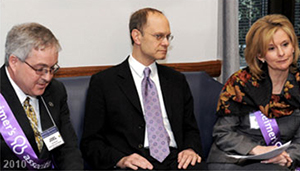
September 21, 2010 Concluding the Alzheimer's Breakthrough Ride, on World Alzheimer's Day participants cycled to Capitol Hill and presented more than 110,000 petition signatures for delivery to Congress. The petition called for passage of the National Alzheimer's Project Act and two other Alzheimer's Association priorities.

Researchers who participated in the Alzheimer's Breakthrough Ride visited Capitol Hill to meet with more than 50 Members of Congress, urging their support for NAPA.

Later that day, the Alzheimer's Association delivered a message in support of NAPA at a special White House briefing on Alzheimer's disease. Harry Johns, Alzheimer's Association President and CEO, and National Board Member Stephen Hume, Psy.D., an individual living with the disease, made presentations at the meeting, focusing on the urgent need for a coordinated national Alzheimer's strategy and for its swift implementation. See the full video of the White House meeting.
July 30, 2010 The Alzheimer's Association President and CEO Harry Johns, former National Board Public Policy Chair Bettylu Saltzman, and Public Policy Vice President Robert Egge meet again with Pete Rouse, one of President Obama's top aides, to solicit the Administration's support for NAPA and for creating a national strategy to combat Alzheimer's disease.
Summer 2010 The Alzheimer's Association's President and CEO, Harry Johns, and the federal affairs team make the rounds on Capitol Hill, meeting with members of Congress and staff to drum up support for NAPA and to plan strategy on how to enact the bill by the end of the year.
March 9, 2010 Alzheimer's Association Advocacy Forum attendees march on Capitol Hill to meet with their Members of Congress, urging their support for the National Alzheimer's Project Act.


David Hyde Pierce joins advocates from Iowa to meet with Sen. Chuck Grassley (R-Iowa).
February 2, 2010 With active collaboration and drafting support from the Alzheimer's Association, the National Alzheimer's Project Act is reintroduced by Senator Evan Bayh and Senator Susan Collins in the Senate (S.3036) and by Rep. Ed Markey and Rep. Chris Smith (H.R.4689) in the House. The Alzheimer's Association immediately endorses the reintroduced bill.
July 31, 2009 Based on the Alzheimer's Study Group recommendations and following consultations with the Alzheimer's Association, Sen. Mel Martinez introduces the first National Alzheimer's Project Act in Congress. The Alzheimer's Association immediately endorses the bill.
July 20, 2009 The Alzheimer's Association President and CEO Harry Johns, former National Board Public Policy Chair Bettylu Saltzman, and Public Policy Vice President Robert Egge meet with Pete Rouse, one of President Obama's top aides, to discuss the Alzheimer's crisis and introduce the need for a bold, coordinated national Alzheimer strategy to address it.
March 25, 2009 Alzheimer's Study Group releases its final report, A National Alzheimer's Strategic Plan: The Report of the Alzheimer's Study Group. The report calls for the creation of a National Alzheimer's Strategy and an Alzheimer's Project Office within the federal government. Harry Johns, President and CEO of the Alzheimer's Association, pledged, "You can be assured that the Alzheimer's Association will play a leading role in seeking the enactment of the core recommendations present in the ASG report."

That same day, advocates attending the 2009 Alzheimer's Association Advocacy Forum visited their Members of Congress urging support for these key Alzheimer's Study Group recommendations, the beginning of the Association's ongoing campaign to accomplish this objective in the 111th Congress.
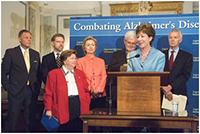
Register now to attend the 2011 Alzheimer's Association Advocacy Forum.
July 11, 2007 With endorsement of, and financial and in-kind support from, the Alzheimer's Association, the Alzheimer's Study Group is launched at a Capitol Hill Conference. The Alzheimer's Study Group is also endorsed at the launch event by then Alzheimer's Disease Task Force co-chairs, then-Senator Hillary Clinton and Senator Susan Collins, and Rep. Ed Markey and Rep. Chris Smith, as well as by Senator Barbara Mikulski and Senator Richard Burr.
July 2007 Speaker Newt Gingrich and Robert Egge author an article in Alzheimer's and Dementia: The Journal of the Alzheimer's Association. This article, "Developing a National Alzheimer's Strategy Equal to the Epidemic," first makes the case for the creation of a federal Alzheimer strategy.

Alzheimer's Association National Office 225 N. Michigan Ave., Fl. 17, Chicago, IL 60601
Alzheimer's Association is a not-for-profit 501(c)(3) organization

Tuesday, November 16, 2010

Finding a Cure for Alzheimer's

Finding a Cure for Alzheimer's Video

Sent to me from a childhood friend, great news. Thanks Debbie!

Dr. Paul Greengard is closer than anyone else to finding a cure for Alzheimer's disease. He invited Dr. Manny into his lab to find out more about his latest discovery which could help to abolish the condition.
Share |